
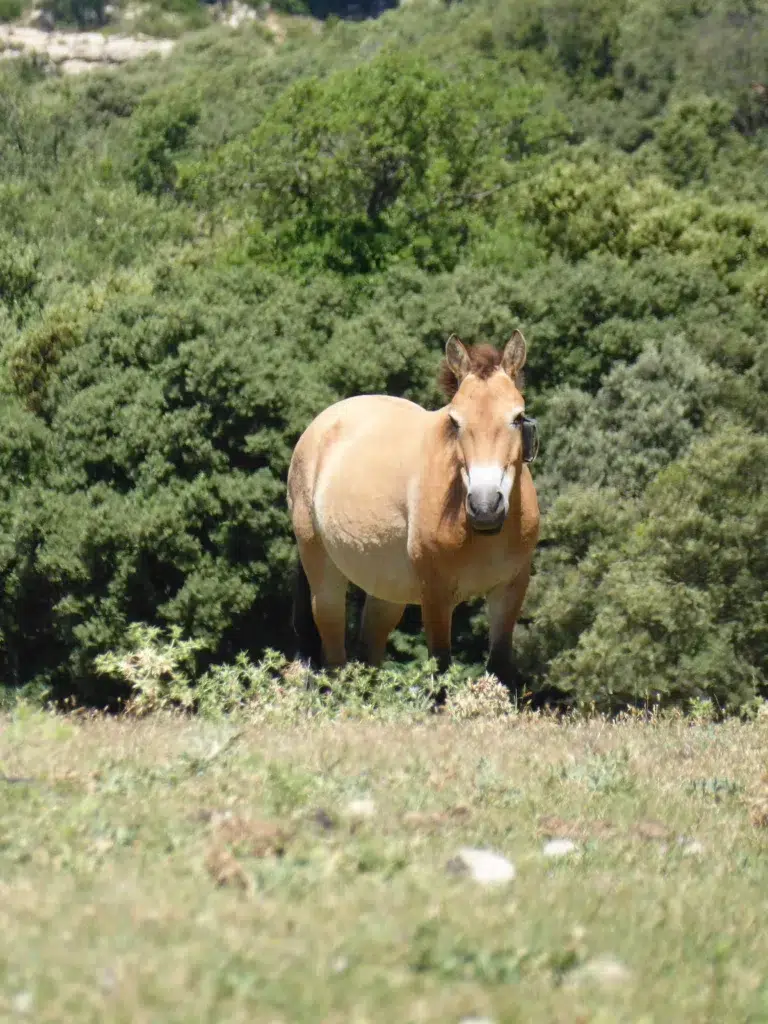
Els horses de Przewalski, one of the oldest equine lines still walking free. They are the last truly wild that survive today. A living memory of the evolution of horses, which have shared the landscape with humans for millennia.
Currently and are considered endangered on a global scale by the Red List of Threatened Species of the International Union for Conservation of Nature (IUCN).
It is estimated that around 2.000 specimens survive, distributed between captive breeding centers and a few locations where they live in the wild or in semi-freedom. Horses with their characteristics appear painted by our Paleolithic ancestors in caves such as those of Lascaux (France).
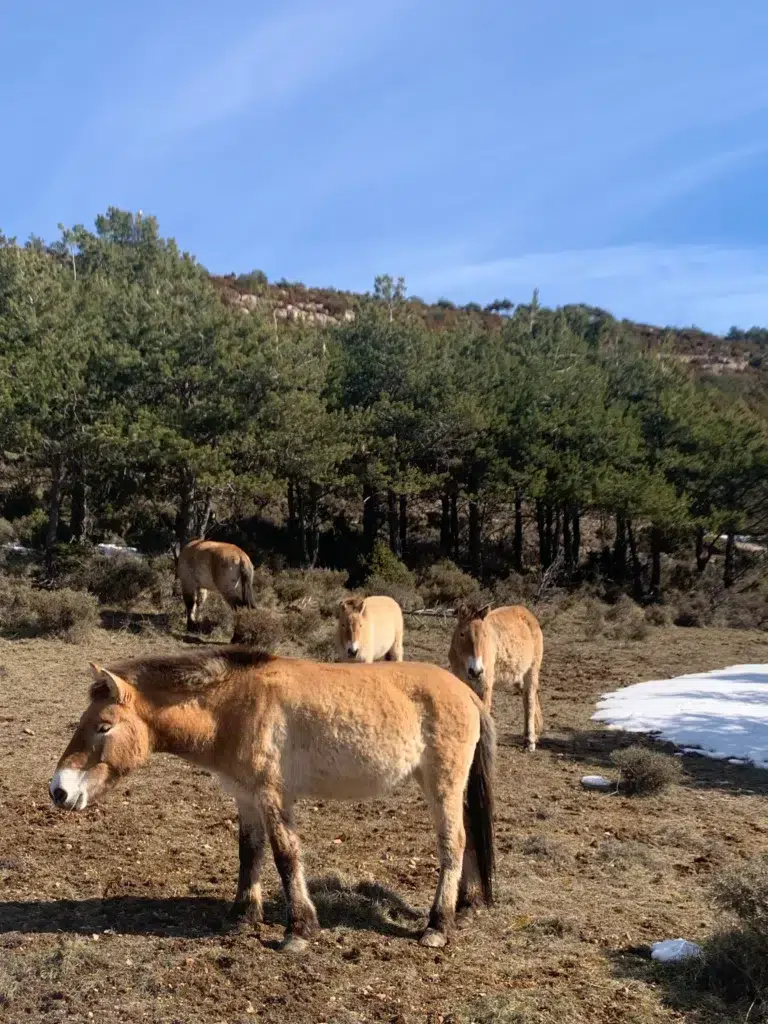
In June 2017 we rescue four horses Przewalski's monkey from the closed zoo in Almuñécar, Granada. The FAADA foundation, through Laura Riera, which is in charge of relocating all the animals at the zoo, made the request to the Miranda Foundation and has facilitated the procedures for the relocation of the horses.
By agreement signed by the Foundation with the Boumort National Hunting Reserve (Generalitat de Catalunya), these primitive horses that have almost become extinct live in supervised freedom in 3.000 hectares of the Reserve, where we have an incipient project (Catalonia wild horses) of reproduction, reintroduction, observation and dissemination.
This project is in the initial design and development phase. It is currently focused on taking care of the welfare of the horses, and in the future it is planned to reproduce and gradually conquer part of the extensive territory of the Reserve (13.000 hectares).
The space and its extension give the project a uniqueness that could make it unique in Europe and coherent with the Miranda Foundation's purpose of promoting free life of horses and the custody of the territory with the introduction of this large herbivore.
The project also plans to carry out studies on horse behavior and its effect on the vegetation of the Reserve, for which the collaboration of the Faculty of Veterinary Medicine of the University of Lleida, and the Forestry Technology Center of Catalonia will be counted. Likewise, its tourist and educational valorization is contemplated, through guided tours that are currently being designed, within the framework of the project to revitalize the Boumort RNC, approved by the Advisory Board of the Reserve.
The promoters of the initiative thank the collaboration of all the people and entities that have made this transfer possible: entities, veterinary professionals, staff of the Almuñécar Zoo, transporter and guards of the reserve, as well as the Almuñécar City Council and the Catalunya-La Pedrera Foundation that contacted the Miranda Foundation with the Boumort Management.
Przewalski's horse remains the last truly wild horse
For years, an idea shook the world of science and conservation: what if Przewalski's horse, considered for more than a century the last wild horse on the planet, wasn't it really wild?
In 2018, a highly publicized study proposed that these horses were actually the feral descendants of the first horses domesticated about 5.500 years ago in Botai, Kazakhstan. If this hypothesis was true, it meant that there was no remaining population of horses that had ever been domesticated by humans.
The news had a huge impact. It appeared in scientific journals, the media and documentaries, and many took it for granted.
But science has a great virtue: hypotheses are not definitive truths. They only survive if new evidence confirms them.
A species that does not fit with a domestic past
From a biological point of view, the Przewalski's horse has always presented own characteristics of a genuinely wild animal.
It has a larger brain than that of domestic horses, retains a robust skull that does not show the typical changes of domestication, maintains a high capacity for defense and aggression when necessary, even in captivity, and does not present many of the genetic alterations that domesticated animals tend to accumulate over thousands of years of human selection.
For this reason, the hypothesis that it had a domestic origin always generated doubts among many specialists.
Were Botai horses really domesticated?
Shortly after the original study was published, several researchers began reviewing the archaeological evidence from the Botai site.
For many years, it was interpreted that its inhabitants raised and milked horses. However, new analyses suggest that much of the evidence can also be explained by intense hunting activity.
The teeth marks that had been attributed to the bridle could be natural. The fats found on the pottery could come from meat and not necessarily from milk. And numerous horse bones show injuries caused by hunting weapons.
It is possible that there were some trained horses at Botai. But it is also clear that large numbers of wild horses were hunted there.
This considerably weakened the idea that all the horses at that site were domestic.
The definitive answer came with more genomes
Science often advances by expanding the sample.
In 2025, a much more comprehensive study was published that analyzed hundreds of genomes of old horses coming from different regions of Eurasia.
The results completely changed the interpretation.
Przewalski's horses are not descended from Botai horses. Both are descended from a much older and more extensive population of wild horses that inhabited Central Asia and the Ural region before domestication.
In other words, they share an ancestor, but not a direct relationship of descent.
The difference is fundamental.
These are not ancient domestic horses that returned to the wild.
These are the last living representatives of an ancient lineage of completely wild horses.
Great news for conservation
This change in perspective is much more than an academic discussion.
It means that the horse of Przewalski It remains the only species of horse that has survived to this day without having gone through the process of domestication.
Each individual living in freedom today represents one unique evolutionary heritage, a window open to the past of the Eurasian steppes and the natural history of the horse.
Conserving it does not mean protecting an ancient domestic breed returned to the wild.
It means preserving the last living witness to the original wild horse.
What does this story teach us?
This case also reminds us of an important lesson about how science works.
Big claims generate a lot of interest and often make the rounds around the world. But science doesn't advance with headlines, but with new data, more samples and a constant revision of hypotheses.
The proposal that Przewalski's horse was a feral animal was stimulating and opened a necessary debate. However, more recent research points in a different direction.
Today, everything indicates that Przewalski's horse continues to be what we have believed it to be for decades: the last truly wild horse on the planet.
For projects like the Miranda Foundation, dedicated to the conservation of equines and the ecological processes they make possible, this is extraordinary news. It reinforces the value of protect this species not only for its beauty or its uniqueness, but because it represents a unique biological heritage, the result of hundreds of thousands of years of evolution in freedom.
The fact that these horses are, according to the most recent scientific evidence, the last genuinely wild horses on the planet gives even more significance to this achievement. Not only has the disappearance of a species been avoided, but a unique lineage has been preserved that connects directly to the evolutionary history of the horse before its domestication.